Generative Engine Optimization (GEO) vs SEO: How to Get Cited by AI Search
AI Overviews and chat search are changing how people find websites. Learn what GEO is, how it differs from SEO, and practical steps to make your pages easier for AI to cite.

In this article expand_more
- What Is Changing?
- SEO vs GEO in Short
- Practical GEO Steps
- 1. Lead with the answer
- 2. Structure the page
- 3. Cover real questions with a FAQ
- 4. Cite your sources and show expertise
- 5. Write clearly
- 6. Optimise titles and descriptions
- 7. Keep key pages fresh
- 8. Make the technical basics solid
- What Not to Waste Time On
- How to Measure Progress
- Frequently Asked Questions
- Is GEO replacing SEO?
- How do I get ChatGPT or Google AI Overviews to cite my site?
- Should I block AI crawlers?
- Do small sites have a chance?
Search no longer ends with ten blue links. Google shows AI Overviews at the top of many results, and millions of people ask ChatGPT and similar tools instead of searching at all. That has created a new discipline called generative engine optimization (GEO): making your content easy for AI systems to find, understand and cite. This guide explains what is changing, how GEO differs from classic SEO, and what you can do today. It draws on research from Ahrefs and LLMrefs, linked at the end.
What Is Changing?
- Fewer clicks. Ahrefs estimated that AI Overviews reduce click-through to the top result by about 58 percent. That is an estimate from one data set, but the direction matches what many site owners report.
- Interest is surging. Ahrefs found searches for "generative engine optimization" grew roughly tenfold over 18 months, and "GEO vs SEO" grew at a similar pace.
- More automated visitors. Cloudflare's chief executive said agent and bot traffic passed half of all internet traffic in mid-2026, per the same Ahrefs piece.
- Different questions. People type longer, more conversational questions into AI tools than into a search box.
SEO vs GEO in Short
- SEO aims to rank a link high on a results page and earn the click. Its measures are rankings, clicks and traffic.
- GEO aims to be cited or mentioned inside an AI-written answer. Its measures are citations, mentions and the quality of the visits they bring.
They are not rivals. AI tools often use live web search, so strong SEO fundamentals, such as quality content, technical health, authority and backlinks, still feed GEO. Think of GEO as SEO plus clearer structure and stronger evidence.
Practical GEO Steps
1. Lead with the answer
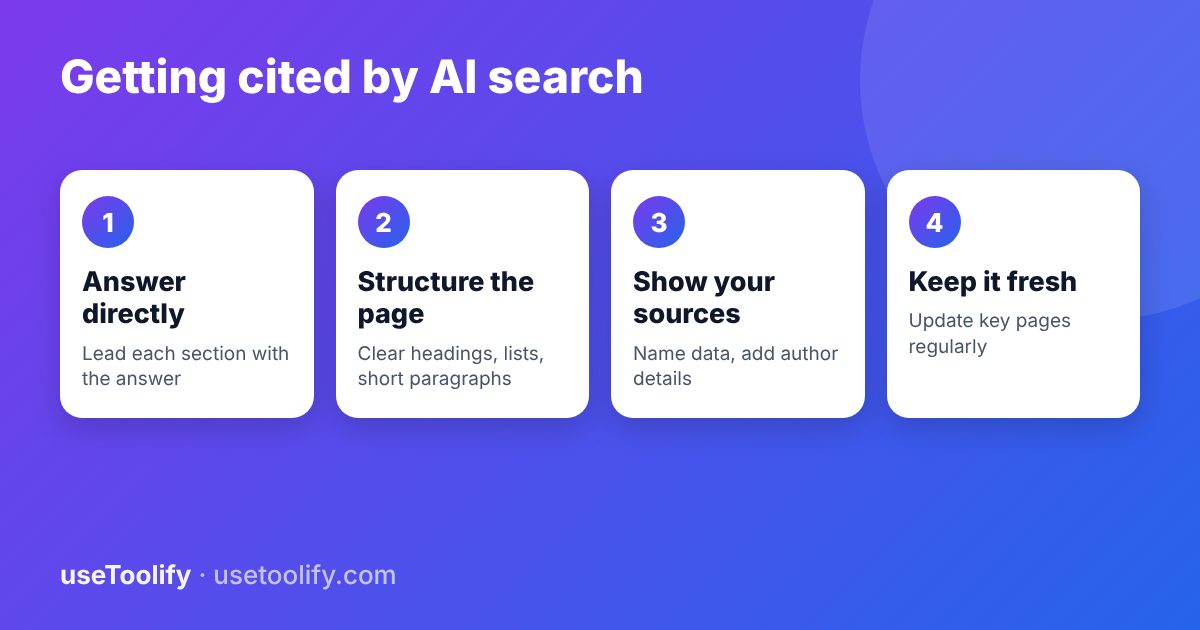
Start each section with a one- or two-sentence direct answer, then add detail. AI systems pull short, self-contained passages, and so do featured snippets. If a heading is a question, answer it immediately underneath.
2. Structure the page
Use a clear heading hierarchy, one idea per section, short paragraphs, and lists or tables for steps and comparisons. A study reported by LLMrefs found pages with structured lists, quotes and statistics had 30 to 40 percent higher AI visibility, though you should treat any single study with caution. Our Blog Outline Generator can give you a clean heading structure to start from.
3. Cover real questions with a FAQ
Add a short FAQ section with honest, specific answers, and mark it up with FAQ structured data where it makes sense. The FAQ Generator can help you draft the questions people ask.
4. Cite your sources and show expertise
Name the origin of every statistic, attribute quotes, and show who wrote the page and why they know the topic. Original data, worked examples and first-hand experience are hard for AI to invent and valuable to cite.
5. Write clearly
Plain, well-organised writing is easier for people and models. Check readability with the Readability Analyzer, and tighten long sentences.
6. Optimise titles and descriptions
These still shape how your page appears. Use the Meta Description Generator for concise descriptions, and the Keyword Extractor to find the phrases a page already emphasises.
7. Keep key pages fresh
Update important pages regularly with new data and a visible "last updated" date. LLMrefs reports that AI citations fall off once content gets old, with a figure of about three months, so schedule a quarterly refresh for your best pages.
8. Make the technical basics solid
Fast loading, clean HTML, crawlable pages, correct canonical tags and working sitemaps matter for both search engines and AI crawlers. If your pages render empty to crawlers, no technique will help.
What Not to Waste Time On
- Chasing tricks. Ahrefs reported that 97 percent of llms.txt files it analysed were never read by the crawlers it checked, so do not expect that file to deliver results by itself.
- Mass-produced thin pages. Ahrefs noted that Google's 2026 updates penalised many sites that scaled low-value programmatic content. Useful tool pages and thorough guides hold up better.
- Tracking only rankings. Also look at whether visits from AI sources convert, not only whether you were cited.
How to Measure Progress
- Watch Google Search Console impressions and clicks together. Pages whose impressions hold steady while clicks fall may be losing to AI answers.
- In your analytics, look at referrals from AI tools and check whether those visitors take action.
- Test a list of your target questions in a few AI tools each month and note whether you are cited.
Frequently Asked Questions
Is GEO replacing SEO?
No. The two overlap heavily. Good SEO still supports visibility in AI answers, and GEO adds attention to structure, evidence and freshness.
How do I get ChatGPT or Google AI Overviews to cite my site?
There is no guaranteed method. Answer questions directly, show evidence, keep pages fast and crawlable, and build authority with quality content and links.
Should I block AI crawlers?
It is a business decision. Blocking may reduce the chance of being cited, while allowing access may mean your content is used without a click. Decide based on your goals and read each provider's crawler documentation.
Do small sites have a chance?
Yes. Specific, well-structured and genuinely helpful pages on narrow topics can be cited even when the site is not famous.
Sources and further reading: Ahrefs: 5 AI search trends in 2026; LLMrefs: Generative Engine Optimization guide. Figures are the publishers' own estimates and may change.
arrow_back Previous
How to Make a Passport-Size Photo at Home (Free and Print-Ready)
Next arrow_forward
AI Agents Explained for Beginners: What They Are and How to Use Them Safely
Get new tool tutorials in your inbox
No spam — just new posts, occasionally.
Comments (0)
No comments yet — be the first to share your thoughts.