What Are AI Tokens and Context Windows? A Plain-English Explanation
Every AI model reads and bills in tokens and forgets anything outside its context window. Learn what tokens are, how to count them, and why long chats get expensive and forgetful.

In this article expand_more
- What Is a Token?
- Why Some Text Uses More Tokens
- What Is a Context Window?
- How Big Are Context Windows Now?
- Input, Output and Total Tokens
- Why Long Chats Cost More
- How to Count Tokens
- Practical Tips
- Frequently Asked Questions
- How many words is 1,000 tokens?
- What happens when I exceed the context window?
- Is a bigger context window always better?
- Do tokens and words cost the same in every language?
If you use ChatGPT, Claude, Gemini or any AI API, two words keep appearing: tokens and context window. They explain why a long chat suddenly forgets the beginning, why an AI app costs what it does, and why the same text can cost more in one language than another. This guide explains both in plain English. You can count tokens for any text with the free Token Counter and check whether a document fits with the Context Window Calculator.
What Is a Token?
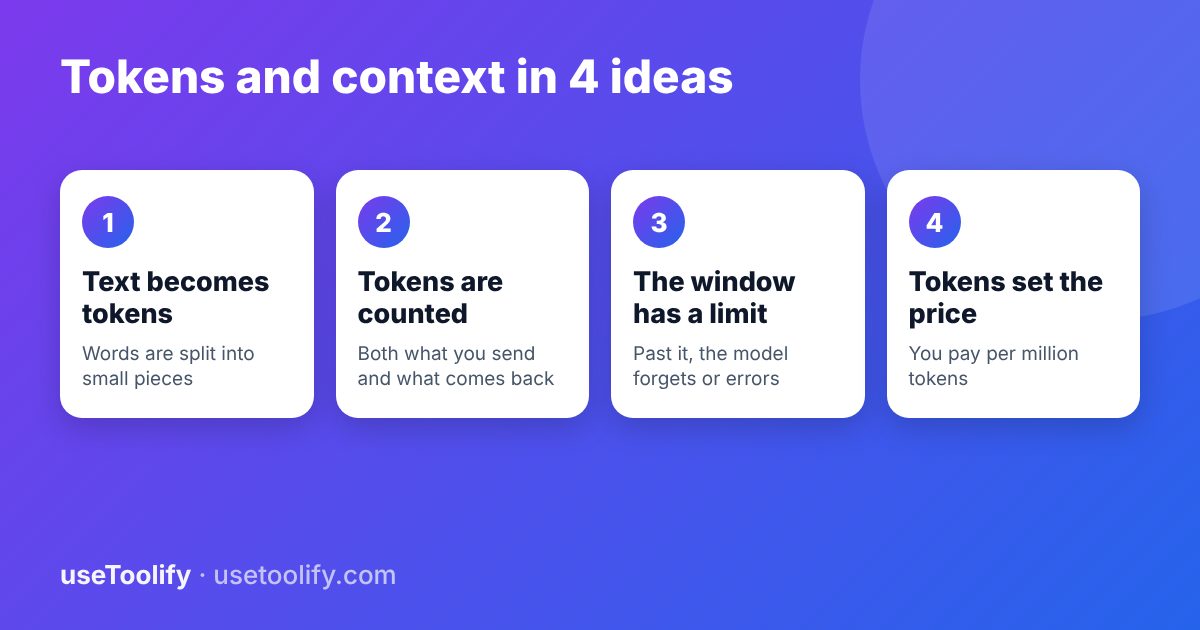
A language model does not read letters or whole words. It first splits text into small chunks called tokens, and then works with those. A token can be a whole common word ("the"), part of a longer word ("un" + "believ" + "able"), a single punctuation mark or even a space.
A handy rule of thumb for English is that one token is about four characters, or roughly three quarters of a word. So 100 tokens is about 75 words, and a 1,000-word article is around 1,300 tokens. The exact numbers depend on the model, because each family uses its own tokenizer.
Why Some Text Uses More Tokens
- Other languages. Tokenizers are usually trained mostly on English, so languages such as Hindi, Tamil or Arabic often need noticeably more tokens for the same meaning.
- Code and numbers. Symbols, indentation and long numbers split into many small tokens.
- Rare words, names and typos are broken into several pieces.
- Formatting. Markdown tables, JSON and repeated whitespace all add tokens.
What Is a Context Window?
The context window is the maximum number of tokens a model can consider at one time. It holds everything: your instructions, the whole conversation so far, any documents you pasted, and the answer the model is writing. Once the total goes over the limit, something has to give. The app may drop the oldest messages, refuse the request, or cut the answer short.
This is why a very long chat can seem to "forget" what you said at the start. The beginning was pushed out of the window, or the model is paying less attention to the middle of a huge prompt.
How Big Are Context Windows Now?
They have grown fast. Older models handled a few thousand tokens. Many current models advertise 200,000 tokens, and a number of flagship models now list around one million, which is enough for several books. A few open models claim even more. A bigger window lets you paste longer documents, but it does not guarantee the model will use all of it well, and you still pay for every token you send. Always check the current figure for the exact model you use, because these numbers change often.
Input, Output and Total Tokens
Providers count input tokens (what you send) and output tokens (what the model writes) separately, and output is usually priced higher. The context window must hold both. If a model has a 128,000-token window and you send 120,000 tokens, only about 8,000 remain for the answer.
Why Long Chats Cost More
Chat apps resend the whole conversation with every new message. That means cost grows faster than the number of turns. If each turn adds about 300 tokens:
- Turn 1 sends 300 tokens, turn 2 sends 600, turn 3 sends 900, and so on.
- After 10 turns the total sent is 300 x (1 + 2 + ... + 10) = 16,500 tokens, not 3,000.
Starting a fresh chat for a new topic, or asking the model to summarise the conversation and continuing from that summary, cuts the cost and also keeps the model focused.
How to Count Tokens
- Paste your text into the Token Counter to see an estimate of its token count.
- Compare that number with the model's window using the Context Window Calculator, leaving room for the answer.
- Turn tokens into money with the Cost Estimator once you know the model's price per million tokens.
Practical Tips
- Put the important instructions at the start, and repeat key constraints near the end of long prompts.
- Send only the parts of a document that matter instead of the whole file.
- Ask for a specific length or format so the model does not write more than you need.
- Remove boilerplate such as signatures and disclaimers before pasting emails.
- Use a smaller, cheaper model for simple tasks and a larger one only when needed. The AI Model Comparison tool helps you weigh them.
Frequently Asked Questions
How many words is 1,000 tokens?
About 750 English words, though the exact figure varies by model and by the kind of text.
What happens when I exceed the context window?
Depending on the app, older messages are dropped, the request fails with an error, or the answer is truncated. None of these is good, so check the size first.
Is a bigger context window always better?
No. It lets you include more, but long prompts cost more, run slower, and models can miss details buried in the middle. Relevant, trimmed context usually works better than a data dump.
Do tokens and words cost the same in every language?
No. Many non-English languages need more tokens per word, so the same text can cost more and fill the window sooner.
arrow_back Previous
How to Estimate LLM API Costs Before You Build an AI Feature
Next arrow_forward
How to Extract Text from a PDF (and When You Need OCR)
Get new tool tutorials in your inbox
No spam — just new posts, occasionally.
Comments (0)
No comments yet — be the first to share your thoughts.