Few-Shot vs Chain-of-Thought Prompting: When to Use Each
Few-shot prompting teaches by example, chain-of-thought teaches by reasoning. Learn the difference, when each helps, how to combine them, and what they cost in tokens.

In this article expand_more
- Zero-Shot: The Starting Point
- Few-Shot: Teach by Example
- Chain-of-Thought: Teach by Reasoning
- The Cost Trade-Off
- Combining the Two
- Quick Comparison
- How to Test Which Works
- Frequently Asked Questions
- How many examples should a few-shot prompt have?
- Does chain-of-thought always improve accuracy?
- Can I use both together?
- Should I trust the reasoning the model shows?
Two prompting techniques come up in almost every guide: few-shot prompting and chain-of-thought prompting. They solve different problems, and people often mix them up. This article explains each in plain language, shows when to use which, and covers the cost trade-off. You can build both kinds of prompt with the free Few-Shot Prompt Builder and Chain-of-Thought Builder.
Zero-Shot: The Starting Point
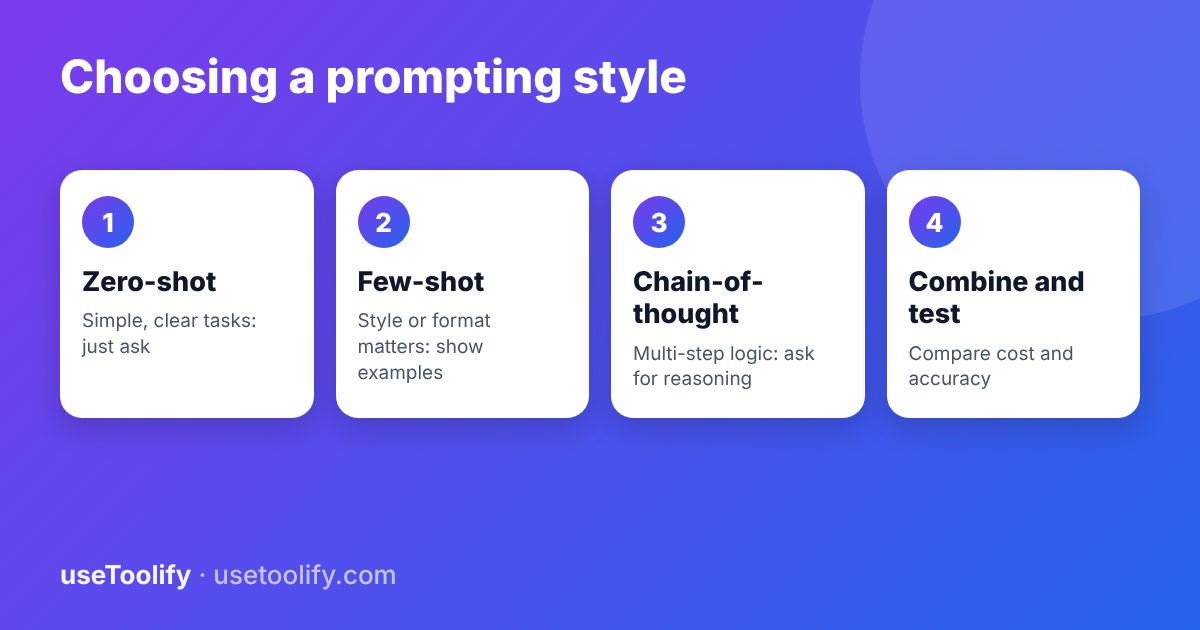
A zero-shot prompt gives the task with no examples: "Translate this sentence into Hindi." Modern models handle many tasks this way. Start here, because it is the cheapest and simplest. Add other techniques only when the result is not good enough.
Few-Shot: Teach by Example
Few-shot prompting includes a handful of input and output examples before your real input. The model picks up the pattern, format and tone from them.
Classify the sentiment as Positive, Negative or Neutral.

Review: "Delivery was quick and the pack was neat."
Sentiment: Positive

Review: "The zip broke on day two."
Sentiment: Negative

Review: "It arrived on Tuesday."
Sentiment: Neutral

Review: "Colours are lovely but the size runs small."
Sentiment:
Use few-shot when:
- You need an exact output format, such as labels, JSON or a fixed template.
- You want to match a particular writing style or brand voice.
- The task is unusual and hard to describe in words but easy to show.
- The model keeps misreading an edge case that an example can clarify.
Tips: use two to five varied, correct examples, keep their format identical, and include at least one tricky case. Bad examples teach bad habits, so check them carefully.
Chain-of-Thought: Teach by Reasoning
Chain-of-thought prompting asks the model to work through the steps before giving a final answer, either with a phrase such as "think step by step" or by showing a worked example.
A shop sells pens at Rs 12 each. A customer buys 7 pens and
pays with a Rs 100 note. How much change does the customer get?
Work through it step by step, then give the final answer on its own line.
The model writes: 7 x 12 = 84, then 100 - 84 = 16, and the final answer is Rs 16. Writing out the intermediate steps tends to reduce slips on problems with several stages.
Use chain-of-thought when:
- The problem has multiple steps, such as arithmetic, logic puzzles or planning.
- You need to justify a decision, for example scoring options against criteria.
- You want to inspect how the answer was reached so you can catch errors.
Be aware that some newer models are trained to reason internally, so an explicit "think step by step" can add little for them. Test it on your own tasks rather than assuming.
The Cost Trade-Off
Both techniques use more tokens. Few-shot examples add to every request's input, and chain-of-thought adds to the output. Because output tokens are usually priced higher, long reasoning can cost more than long examples. Use the Token Counter to measure the difference and the Cost Estimator to see what it means at your volume.
Combining the Two
You can put examples that include their reasoning into a few-shot prompt, so the model sees both the pattern and the steps. A common recipe for a hard classification task is two or three examples, each with a one-line justification, followed by the new item.
Quick Comparison
- Zero-shot - cheapest, good for clear everyday tasks.
- Few-shot - best for format, style and edge cases.
- Chain-of-thought - best for multi-step reasoning and checkable answers.
- Both - for hard tasks where you need consistent format and sound logic.
How to Test Which Works
- Collect 15 to 30 real examples of the task, with the answers you expect.
- Run each style on the same examples.
- Compare accuracy, format consistency and token cost. The Prompt A/B Comparator makes it easy to review versions side by side.
- Keep the simplest style that meets your quality bar.
Frequently Asked Questions
How many examples should a few-shot prompt have?
Usually two to five. More examples cost more, and after a point they add little. Choose varied examples that cover the tricky cases.
Does chain-of-thought always improve accuracy?
No. It helps most on multi-step problems and may add cost without benefit on simple tasks or with models that already reason internally.
Can I use both together?
Yes. Provide examples that show the reasoning steps and the final answer.
Should I trust the reasoning the model shows?
Treat it as a helpful clue, not proof. The written steps can sound convincing and still contain mistakes, so verify important results.
arrow_back Previous
How to Write a System Prompt (and Choose the Right Temperature)
Next arrow_forward
How to Write Better AI Prompts: 8 Techniques That Still Work in 2026
Get new tool tutorials in your inbox
No spam — just new posts, occasionally.
Comments (0)
No comments yet — be the first to share your thoughts.