How to Write Better AI Prompts: 8 Techniques That Still Work in 2026
Better prompts get better answers. Learn eight reliable techniques, including role, context, output format, examples and step-by-step reasoning, with before and after examples.

In this article expand_more
- 1. State the Task Clearly
- 2. Give the Model a Role
- 3. Provide Context
- 4. Specify the Output Format
- 5. Show Examples
- 6. Ask for Reasoning on Hard Problems
- 7. Set Boundaries
- 8. Test, Compare and Iterate
- A Full Before and After
- Mistakes to Avoid
- Frequently Asked Questions
- Is prompt engineering still important in 2026?
- How long should a prompt be?
- Should I say "please" or use special tricks?
- How do I know if my prompt is good?
Two people can ask the same AI the same question and get very different answers. The difference is almost always the prompt. Models have changed a lot, but the basics of a good prompt have stayed remarkably stable: be clear about the task, supply the context, describe the output, and test what you get. This guide covers eight techniques with before-and-after examples. You can build and improve prompts with the free Prompt Optimizer and Prompt Builder.
1. State the Task Clearly
Say exactly what you want done, in one or two plain sentences.
- Weak: "Tell me about marketing."
- Better: "Explain three low-cost ways a small bakery can attract local customers this month."
2. Give the Model a Role
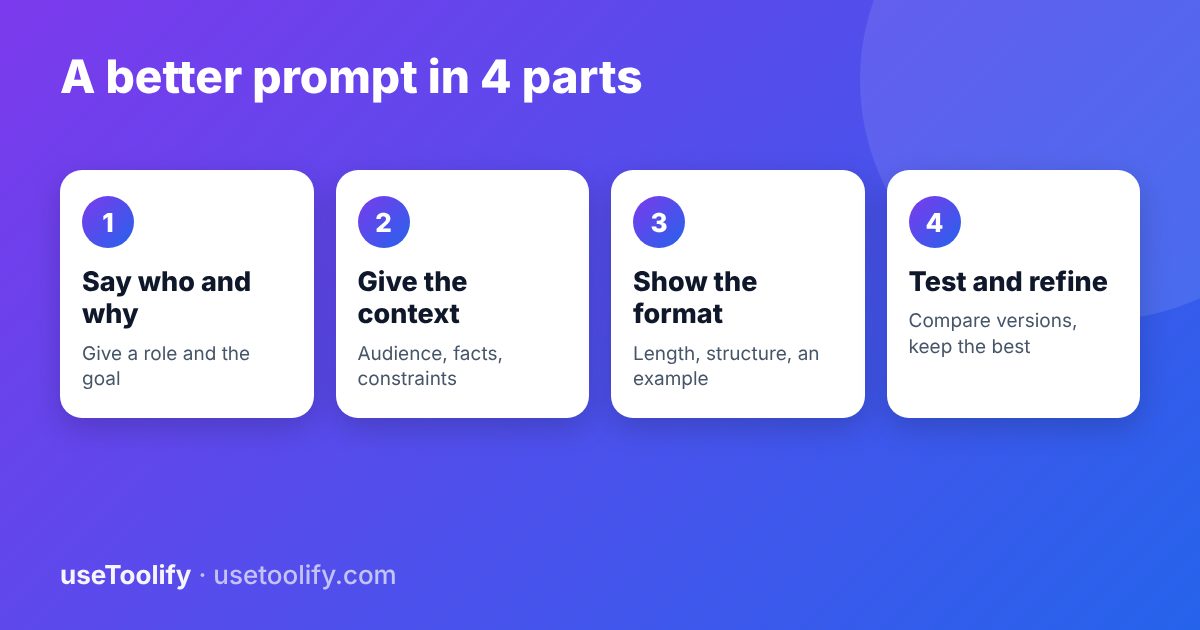
A role sets tone and depth. "You are an experienced career coach reviewing a fresher's resume" gives a different answer from no role at all. Keep the role relevant, not theatrical.
3. Provide Context
The model knows nothing about your situation unless you say so. Include who the audience is, what you already tried, relevant facts and any limits (budget, time, tools). More relevant context nearly always beats a longer instruction.
4. Specify the Output Format
Tell it the shape of the answer: a table, five bullet points, a 150-word email, JSON with named fields, or a step-by-step list. For data that another program will read, ask for strict JSON and validate it. The Prompt to JSON tool helps structure such requests.
5. Show Examples
One or two examples of the input and the output you want teach style and format faster than a paragraph of explanation. This is called few-shot prompting, and our guide on few-shot vs chain-of-thought prompting explains when to use it. The Few-Shot Prompt Builder lays the examples out for you.
6. Ask for Reasoning on Hard Problems
For maths, logic or multi-step decisions, ask the model to work step by step before giving the final answer. This can improve accuracy on problems with several stages, though it uses more tokens. The Chain-of-Thought Builder helps you phrase it. For simple tasks it is unnecessary.
7. Set Boundaries
Say what to avoid and what to do when unsure. For example: "Use only the text below. If the answer is not in it, say you do not know." That single line cuts invented answers noticeably.
8. Test, Compare and Iterate
Treat a prompt like a draft. Run it on several realistic inputs, compare versions side by side with the Prompt A/B Comparator, and keep the one that works best. Change one thing at a time so you know what helped.
A Full Before and After
Before: "Write a product description for my candle."
After: "You are a copywriter for a small handmade-candle brand. Write a product description of about 90 words for a soy lavender candle that burns for 40 hours and is poured in small batches in Pune. The audience is gift buyers aged 25 to 40. Tone: warm, calm, not salesy. End with a one-line call to action. Do not claim any health benefits."
The second prompt gives the role, product facts, audience, tone, length and a safety limit, so the first draft is usually close to usable.
Mistakes to Avoid
- Being vague and hoping the model guesses what you want.
- Overloading one prompt with five unrelated tasks. Split them up.
- Contradicting yourself, such as asking for "very detailed but under 50 words".
- Pasting private data you would not want stored or shared.
- Trusting the first answer without checking facts, numbers and names.
Frequently Asked Questions
Is prompt engineering still important in 2026?
Yes. Models follow loose instructions better than before, but clear context, format and examples still give noticeably better and more consistent results, especially in products.
How long should a prompt be?
As long as it needs to be to include the relevant facts and rules, and no longer. Long prompts cost more and can bury key points, so cut anything that does not change the answer.
Should I say "please" or use special tricks?
Politeness does no harm, but clarity matters far more than tricks. Focus on task, context, format and boundaries.
How do I know if my prompt is good?
Test it on several different inputs and check the results against what you wanted. A good prompt works consistently, not once.
arrow_back Previous
Few-Shot vs Chain-of-Thought Prompting: When to Use Each
Next arrow_forward
Prompt Injection Explained: How Attackers Trick AI and How to Defend Your App
Get new tool tutorials in your inbox
No spam — just new posts, occasionally.
Comments (0)
No comments yet — be the first to share your thoughts.