AIDA vs PAS: Two Copywriting Formulas You Can Use With AI (With Examples)
AIDA and PAS are classic copywriting frameworks that work for ads, landing pages and emails. Learn how each works, when to use which, and how to prompt AI to draft them well.
In this article expand_more
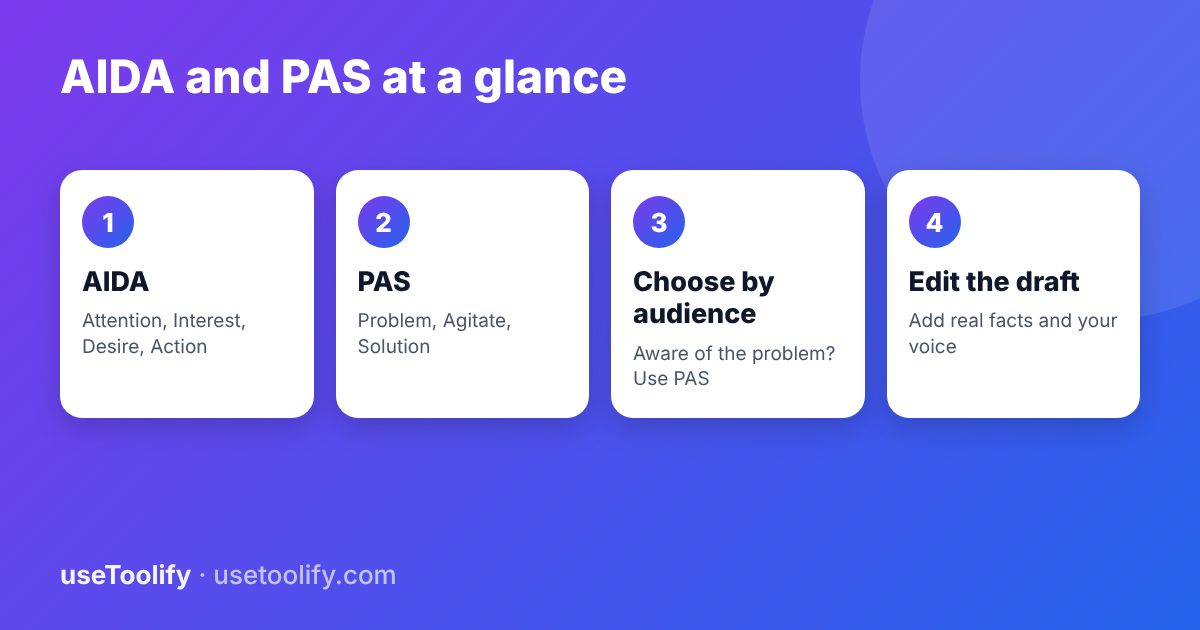
- AIDA: Attention, Interest, Desire, Action
- PAS: Problem, Agitate, Solution
- AIDA or PAS? How to Choose
- How to Prompt AI for Better Copy
- Edit Before You Publish
- Common Mistakes
- Frequently Asked Questions
- What is the difference between AIDA and PAS?
- Can AI write good copy with these formulas?
- Which formula is better for emails?
- Are there other copywriting frameworks?
Good copy rarely starts from a blank page. Professional copywriters lean on a handful of proven structures, and two of the most useful are AIDA and PAS. Both are easy to learn, and they pair well with AI: you supply the facts and the structure, and the AI helps you draft quickly. This guide explains each formula with examples, when to pick which, and how to prompt AI so the result sounds like a real business. You can generate drafts with the free AIDA Framework Generator and PAS Framework Generator.
AIDA: Attention, Interest, Desire, Action
AIDA walks the reader through four stages and is one of the oldest models in advertising.
- Attention - a headline or first line that makes the right person stop.
- Interest - details that keep them reading and show the product is relevant.
- Desire - benefits, proof and emotion that make them want it.
- Action - one clear next step.
Example (online English course):
- Attention: "Speak confidently in job interviews in 30 days."
- Interest: "Our live classes focus on the 50 questions interviewers ask most, with a coach who corrects you on the spot."
- Desire: "Join 1,200 learners who moved from nervous silence to clear, calm answers. Practise with real mock interviews and get written feedback."
- Action: "Book your free trial class today."
(The numbers above are sample copy. Use only real figures for your own business.)
PAS: Problem, Agitate, Solution
PAS starts from the pain.
- Problem - name something the reader already struggles with.
- Agitate - make the cost of the problem vivid, without exaggerating.
- Solution - present your offer as the way out.
Example (invoice software):
- Problem: "Chasing late payments eats your week."
- Agitate: "Every reminder email you write by hand is time you are not spending on clients, and the cash you are owed keeps your own bills waiting."
- Solution: "Send professional invoices in a minute and let automatic reminders follow up for you. Start free."
AIDA or PAS? How to Choose
- Use PAS when the audience already feels a clear problem and is looking for relief, such as emails, short ads and problem-focused landing pages.
- Use AIDA when you are introducing something people may not know they want, or when you need to build interest before the pitch, such as product launches, longer sales pages and brand ads.
- For long pages you can use PAS in the opening and AIDA through the rest.
How to Prompt AI for Better Copy
AI writes generic copy when it gets a generic prompt. Give it the raw material:
- The product and who it is for. Be specific about the customer.
- Real facts and proof: prices, features, results, reviews you actually have.
- The formula you want and the format, such as an 80-word ad or a 5-section landing page.
- Tone and words to avoid. For example, "friendly and plain, no hype words like 'revolutionary'".
- The single action you want the reader to take.
Then use the supporting tools: Headline Generator for attention-grabbing openers, CTA Generator for button text, and Email Subject Line Generator for email campaigns.
Edit Before You Publish
An AI draft is a starting point. Before it goes live:
- Replace any invented statistics, testimonials or guarantees with real ones. Fake proof damages trust and can break advertising rules.
- Remove claims you cannot back up, especially about health, money or results.
- Read it aloud. If it sounds like nobody you know, rewrite it in your own words.
- Check for one clear call to action and no more.
- Test two versions of the headline and keep the one that performs better.
Common Mistakes
- Pushing agitation too far until it feels manipulative.
- Stacking features instead of benefits in the Interest stage.
- Using several different calls to action in one piece.
- Copying the template so literally that the copy sounds robotic.
Frequently Asked Questions
What is the difference between AIDA and PAS?
AIDA moves a reader from noticing, to interest, to desire and action. PAS begins with a pain point, intensifies it, and then offers the solution. PAS suits problem-aware audiences, and AIDA suits broader introductions.
Can AI write good copy with these formulas?
It can draft quickly if you give it real facts and a clear structure. You still need to edit for accuracy, voice and trust.
Which formula is better for emails?
PAS often works well for short emails because it opens with a problem the reader recognises. Test both with your audience.
Are there other copywriting frameworks?
Yes, including BAB (before, after, bridge) and FAB (features, advantages, benefits). AIDA and PAS are simply the most widely used starting points.
arrow_back Previous
How to Create a Free QR Code for Your Business (Sizes, Types and Tips)
Next arrow_forward
How to Create a Strong Password You Can Actually Remember
Get new tool tutorials in your inbox
No spam — just new posts, occasionally.
Comments (0)
No comments yet — be the first to share your thoughts.