Profit Margin vs Markup, and How to Find Your Break-Even Point
Margin and markup are not the same, and mixing them up quietly costs small businesses money. Learn both formulas with examples, plus how to calculate break-even units and revenue.

In this article expand_more
- Margin vs Markup: The Difference
- Going From Margin to Price
- Gross Margin vs Net Margin
- Do Not Forget GST
- What Is Break-Even?
- Worked Example
- Margin of Safety
- How to Improve the Numbers
- Frequently Asked Questions
- What is a good profit margin?
- Is markup or margin higher?
- How do I calculate break-even if I sell several products?
- Should fixed costs include my own salary?
Two numbers decide whether a small business survives: the margin on each sale and the break-even point where total sales cover total costs. People mix up margin and markup all the time, and the confusion leads to underpricing. This guide gives the formulas, worked examples and a simple routine. You can check every number with the free Profit Margin Calculator and the Break Even Calculator.
Margin vs Markup: The Difference
Both describe profit as a percentage, but they divide by different things:
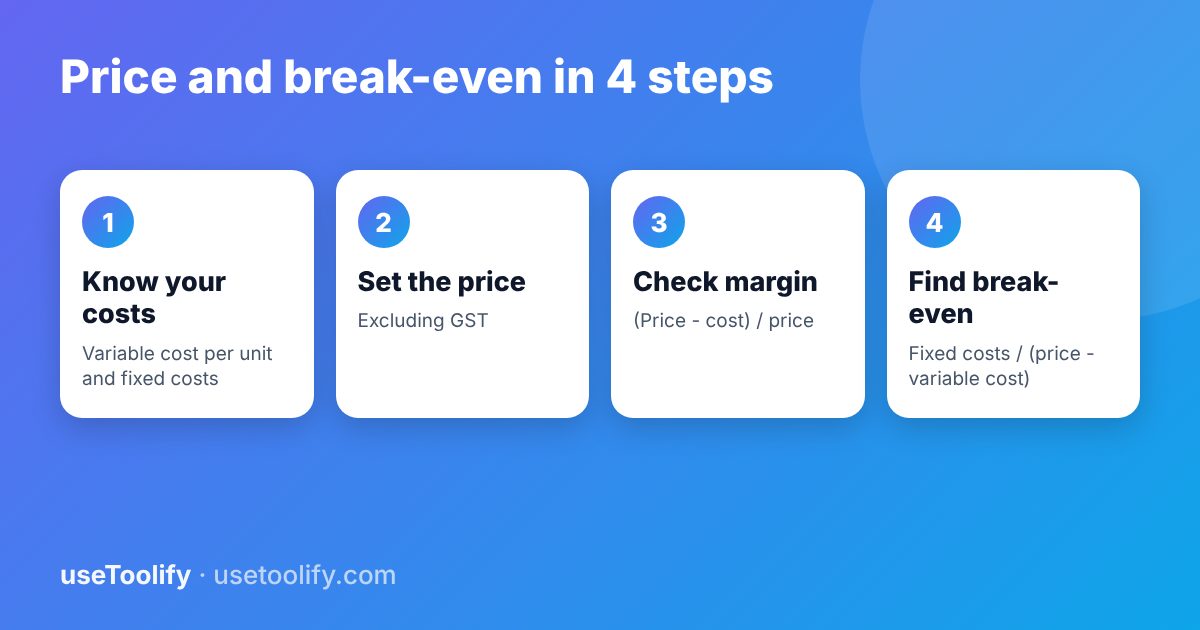
Margin % = (Price - Cost) / Price x 100
Markup % = (Price - Cost) / Cost x 100
Example: a product costs you Rs 100 and you sell it for Rs 150. The profit is Rs 50.
- Margin = 50 / 150 = 33.3%
- Markup = 50 / 100 = 50%
The same sale is a 50 percent markup and a 33 percent margin. If someone says "I need a 30 percent margin" and you add 30 percent to your cost, you will end up with only about a 23 percent margin. That gap is how businesses underprice without noticing.
Going From Margin to Price
If you want a target margin, divide the cost by one minus the margin:
Price = Cost / (1 - Margin)For a cost of Rs 100 and a 40 percent margin, price = 100 / 0.60 = Rs 166.67. A 40 percent markup would give only Rs 140, which is a 28.6 percent margin.
Gross Margin vs Net Margin
- Gross margin counts only the direct cost of the goods or service sold (materials, packaging, direct labour).
- Net margin subtracts everything: rent, salaries, marketing, software, interest and tax.
A shop can have a healthy 45 percent gross margin and still lose money if rent and salaries are too high. Always look at both.
Do Not Forget GST
Margin should be calculated on the price excluding GST, because GST you collect belongs to the government, not to you. If your shelf price is Rs 1,180 including 18 percent GST, your real selling price is Rs 1,000. Use the GST Calculator to separate the two before you work out margin.
What Is Break-Even?
The break-even point is the sales volume where total revenue equals total cost, so profit is zero. Below it you lose money, above it you earn. You need three numbers:
- Fixed costs - costs that do not change with volume, such as rent, salaries, subscriptions and loan EMIs.
- Variable cost per unit - costs that rise with each sale, such as materials, packaging and delivery.
- Selling price per unit, before GST.
Contribution per unit = Price - Variable cost
Break-even units = Fixed costs / Contribution per unit
Break-even revenue = Break-even units x Price
Worked Example
A small bakery has fixed costs of Rs 60,000 a month. Each box of cookies sells for Rs 500 and costs Rs 300 in ingredients, packaging and delivery.
- Contribution per box = 500 - 300 = Rs 200
- Break-even units = 60,000 / 200 = 300 boxes a month
- Break-even revenue = 300 x 500 = Rs 1,50,000
Every box sold after the 300th adds Rs 200 of profit. Selling 450 boxes gives a profit of 150 x 200 = Rs 30,000.
Margin of Safety
The margin of safety is how far sales can fall before you start losing money. If you sell 450 boxes and break even at 300, the margin of safety is (450 - 300) / 450 = 33 percent. A small cushion means a slow month hurts quickly.
How to Improve the Numbers
- Raise the price a little. Even a 5 percent rise can lift profit a lot when margins are thin.
- Cut variable cost by buying in bulk, changing packaging or negotiating delivery rates.
- Reduce fixed costs such as unused subscriptions or oversized premises.
- Drop products that do not cover their own costs, or bundle them with strong sellers.
Use the Break Even Calculator to test each change before you make it, and the Percentage Calculator for quick price changes.
Frequently Asked Questions
What is a good profit margin?
It depends on the industry. Retail often has lower margins and software or services higher ones. Compare against similar businesses and make sure the margin covers all your costs, not only the product cost.
Is markup or margin higher?
For the same sale, markup is always higher than margin, because it divides by the lower cost figure instead of the price.
How do I calculate break-even if I sell several products?
Use the average contribution per unit weighted by how many of each product you sell, or calculate break-even in revenue using your overall margin percentage.
Should fixed costs include my own salary?
Yes. If you do not pay yourself, your break-even looks lower than it really is.
Try the tools mentioned in this article
Free, browser-based, no account needed.
arrow_back Previous
How to Convert PDF to JPG and JPG to PDF Free (Without Losing Quality)
Next arrow_forward
Rent Receipts for HRA Exemption: What You Need and How to Create Them
Get new tool tutorials in your inbox
No spam — just new posts, occasionally.
Comments (0)
No comments yet — be the first to share your thoughts.