How to Calculate Percentage Increase, Decrease and Discounts (With Examples)
Percentages show up in prices, marks, salaries and sales. Learn the formulas for percentage change, discounts, successive discounts and reverse percentages, with worked examples.

In this article expand_more
- What Is a Percentage?
- Percentage Increase
- Percentage Decrease
- Finding the Value After a Percentage Change
- Discount Calculations
- Successive Discounts Do Not Add Up
- Reverse Percentages: Finding the Original Price
- Percentage Points vs Percent
- Marks and Averages
- Quick Mental Tricks
- Common Mistakes
- Frequently Asked Questions
- How do I calculate percentage increase?
- How do I find the original price after a discount?
- Why is a 50 percent drop followed by a 50 percent rise not back to the start?
- What is the quickest way to calculate 18 percent of a number?
Percentages are everywhere: a 20 percent discount, a 7 percent salary hike, a drop in exam marks, a rise in petrol prices. The maths is simple once you know which number to divide by. This guide covers the formulas people need most, with worked examples you can check in the free Percentage Calculator.
What Is a Percentage?
"Percent" means "out of a hundred". 25 percent is 25 out of 100, or 0.25 as a decimal. To find a percentage of a number, multiply by the decimal:
20% of 450 = 450 x 0.20 = 90Percentage Increase
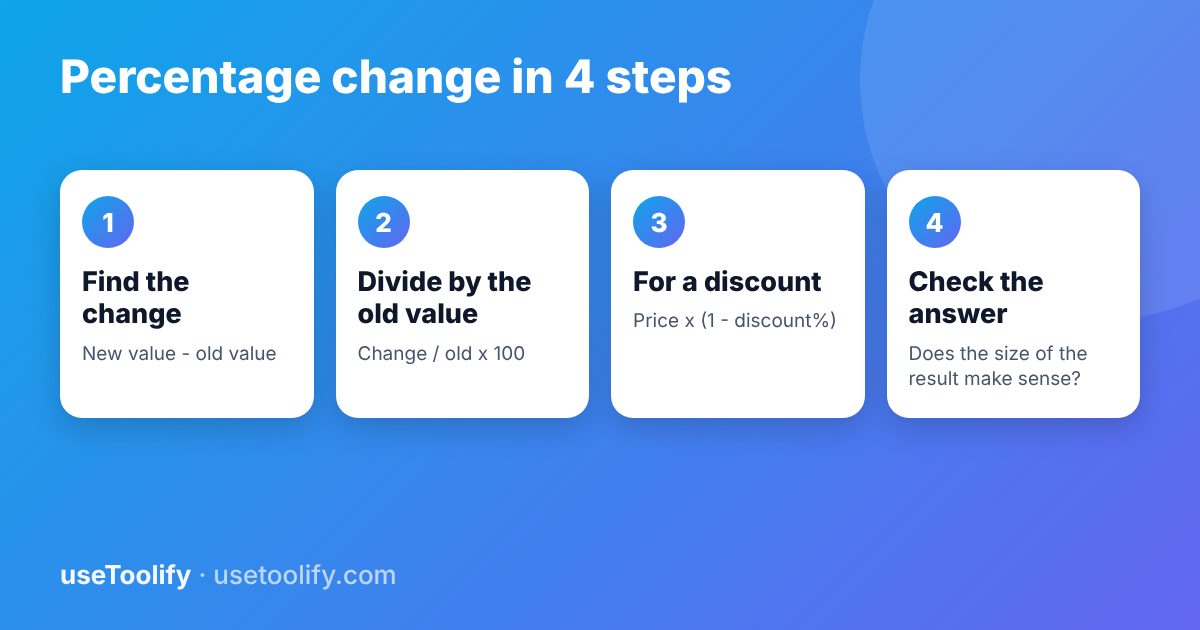
Increase % = (New value - Old value) / Old value x 100Example: a monthly rent goes from Rs 8,000 to Rs 10,000.
- Change = 10,000 - 8,000 = 2,000
- Increase = 2,000 / 8,000 x 100 = 25%
Percentage Decrease
Decrease % = (Old value - New value) / Old value x 100Example: a phone drops from Rs 20,000 to Rs 16,000.
- Change = 4,000
- Decrease = 4,000 / 20,000 x 100 = 20%
Notice the asymmetry. A rise from 80 to 100 is 25 percent, but a fall from 100 to 80 is only 20 percent. The percentage depends on which value you start from. This is why a 50 percent loss needs a 100 percent gain to get back to where you began.
Finding the Value After a Percentage Change
New value = Old value x (1 + rate)    for an increase
New value = Old value x (1 - rate)    for a decrease
Example: a salary of Rs 40,000 rises by 7 percent. New salary = 40,000 x 1.07 = Rs 42,800.
Discount Calculations
A discount is a percentage decrease.
Discount amount = Price x Discount% / 100
Sale price     = Price - Discount amount
Example: a pair of shoes is marked Rs 2,499 with 20 percent off.
- Discount = 2,499 x 0.20 = Rs 499.80
- Sale price = 2,499 - 499.80 = Rs 1,999.20
Successive Discounts Do Not Add Up
If a shop offers "20 percent off, plus an extra 10 percent off", the total is not 30 percent. The second discount applies to the already reduced price.
Final price = Price x (1 - 0.20) x (1 - 0.10) = Price x 0.72That is a total discount of 28 percent, not 30. On a Rs 1,000 item you pay Rs 720, not Rs 700.
Reverse Percentages: Finding the Original Price
If you know the sale price and the discount, divide, do not add back the percentage.
Original = Sale price / (1 - Discount%)Example: a jacket costs Rs 1,800 after a 25 percent discount. Original = 1,800 / 0.75 = Rs 2,400. If you wrongly added 25 percent to 1,800 you would get Rs 2,250.
The same idea works for tax. If a bill includes 18 percent GST, the price before tax is the total divided by 1.18. Our guide to GST inclusive and exclusive prices goes through this in detail, or use the GST Calculator.
Percentage Points vs Percent
If an interest rate rises from 6 percent to 8 percent, it has risen by 2 percentage points, which is a 33.3 percent increase in the rate itself (2 / 6). News stories often confuse the two, so be careful about which one is meant.
Marks and Averages
For exam marks, percentage = marks obtained / total marks x 100. To find an average mark across subjects, add the marks and divide by the number of subjects, which you can do with the Average Calculator. If subjects have different totals, convert each to a percentage first or use weighted marks.
Quick Mental Tricks
- 10 percent: move the decimal point one place left. 10 percent of 640 is 64.
- 5 percent: take half of 10 percent.
- 15 percent: add 10 percent and 5 percent. For a tip on Rs 840, 84 + 42 = Rs 126.
- 1 percent: divide by 100, then multiply to get any other percentage.
Common Mistakes
- Dividing by the new value instead of the old value.
- Adding successive percentages instead of multiplying.
- Calculating a discount from the discounted price when you want the original price.
- Mixing up percentages and percentage points.
Frequently Asked Questions
How do I calculate percentage increase?
Subtract the old value from the new value, divide by the old value, and multiply by 100.
How do I find the original price after a discount?
Divide the sale price by (1 minus the discount as a decimal). For 25 percent off, divide by 0.75.
Why is a 50 percent drop followed by a 50 percent rise not back to the start?
The rise applies to the smaller number. 100 falls to 50, and a 50 percent rise on 50 only gives 75.
What is the quickest way to calculate 18 percent of a number?
Find 10 percent, add 8 percent (which is 10 percent minus 2 percent) or just multiply by 0.18. A calculator removes the effort and the risk of mistakes.
Try the tools mentioned in this article
Free, browser-based, no account needed.
arrow_back Previous
EMI vs SIP: Understanding the Numbers Behind Loans and Investing
Next arrow_forward
How to Build an ATS-Friendly Resume That Gets Read by a Human
Get new tool tutorials in your inbox
No spam — just new posts, occasionally.
Comments (0)
No comments yet — be the first to share your thoughts.